Sewage Backup in the House: Is It Safe to Stay, and Who Cleans It?
By Ultra Mold & Water Pros 6 min read
Quick answer
If sewage has backed up into your house, keep people and pets out of the affected rooms, stop using every sink, toilet, tub and appliance that drains, and call a plumber to clear the line and a restoration crew to clean up. Staying can be reasonable if the backup is confined to one area you can close off and the drains work again. Children, older adults and anyone ill are better off elsewhere until the cleanup is done. Sewage is Category 3 water, not a job for household tools.
Staying in the house during a sewage backup
It depends on how far the sewage spread, whether you can shut that part of the house off, and whether the drain problem is fixed. A toilet overflow on tile is very different from a main line pushing sewage out of a downstairs shower and across carpet.
- Usually workable: the backup stayed in one bathroom or laundry room with a door you can keep closed, the line has been cleared, and the rest of the plumbing works.
- Better to leave for now: sewage reached carpet, a finished lower level or an HVAC return, the smell fills the house, or the line is still blocked so no drains can be used.
- Leave regardless: someone in the home is an infant, elderly, pregnant, ill, or has a weakened immune system or a respiratory condition. Ask your doctor if you are unsure.
Sewage carries bacteria and viruses. The risk comes from contact and from tracking it through the house, so the affected room should be off limits to everyone except the people cleaning it.
Why sewage counts as Category 3 water
Restoration crews sort water losses by contamination using the ANSI/IICRC S500 categories. The category decides what can be dried and kept and what has to go.
| Category | Typical source | What it means for cleanup |
|---|---|---|
| Category 1 (clean) | Supply line, water heater, ice maker line | Most materials can be dried in place if drying starts promptly |
| Category 2 (gray) | Washer or dishwasher discharge, toilet overflow without feces | Cleaning and antimicrobial treatment; pad usually replaced |
| Category 3 (black) | Sewage, toilet overflow with feces, floodwater from outside | Porous materials that got wet are usually removed and disposed of |
Category can get worse with time. Gray water that sits for a couple of days in a warm house can degrade to Category 3, so a washing machine overflow left over a long weekend gets treated more like sewage.
What to do right now, and what to leave alone
- Stop running water. No flushing, showers, laundry or dishwasher. Every fixture drains into the same line, and each gallon you send down comes back up at the lowest drain.
- Keep people and pets out and close the door to the room if you can.
- Cut power to the area at the breaker if sewage is near outlets, cords or appliances, but only if you can reach the panel without walking through it.
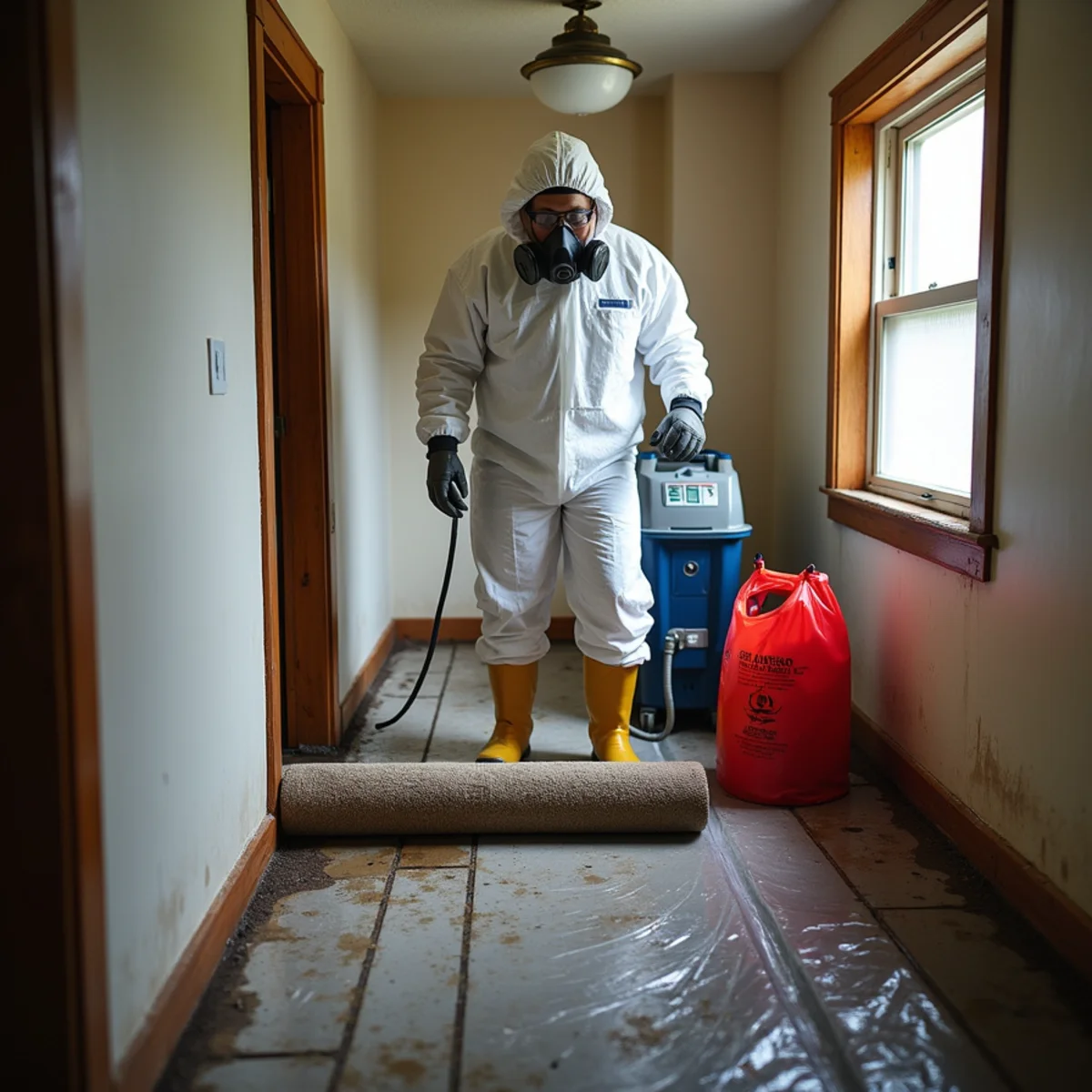
- Put on protection before touching anything: rubber boots, waterproof gloves, eye protection and an N95. Wash up afterward and keep work clothes separate.
- Photograph everything before cleanup starts: the drain it came from, the floor, the damaged contents.
- Call a plumber to clear the line and a restoration crew for the cleanup. If neighbors are backing up too, call your utility.
Surface cleaning is where most do-it-yourself attempts fall short. Sewage wicks into the bottom of drywall, the tack strip and the pad, and a mop leaves all of that behind. EPA's mold cleanup guidance for homes says damage caused by sewage or other contaminated water calls for a professional experienced in repairing buildings hit by contaminated water.
If sewage has reached more than one room, a 24/7 emergency water damage crew can start containment while the plumber works on the line. Call (831) 303-1192 at any hour.
Who cleans it, who clears the line, and who owns the pipe
A sewage backup usually involves three different parties, and calling the right one first saves time.
| Who | What they handle | When to call |
|---|---|---|
| Plumber | Clearing the clog, camera inspection, repairing or replacing the private sewer line | First, if sewage is still coming up or drains will not work |
| Restoration crew | Removing sewage, tearing out contaminated material, cleaning, disinfecting and drying | As soon as the source is stopped |
| Your water and sewer utility | The public sewer main under the street | When neighbors have backups too, or the plumber finds the blockage past your property |
Davidson, Cornelius and Huntersville: Charlotte Water
Charlotte Water provides sewer service in Davidson, Cornelius and Huntersville. As a rule of thumb, the homeowner owns the sewer pipe from the house to the street right-of-way, including the cleanout on the property, and the utility maintains the mains under public streets. Easements and low-pressure systems can change that, so check with Charlotte Water about your line. Its explanation of homeowner and utility pipe responsibility shows the general split.
Kannapolis, Concord and Mooresville: city utilities
Kannapolis runs its own water and sewer system, and the City of Kannapolis water and sewer page lists a Public Works line for sewer problems that is answered around the clock. Concord and Mooresville operate their own utilities too. The same general split applies, but ask your utility where its responsibility begins at your address.
Why older Kannapolis homes back up more often
Kannapolis was built from 1906 as the Cannon Mills company town, and large parts of it are still early and mid-1900s mill houses. Many kept their original drain lines, or had them patched one section at a time over the decades.
- Clay tile sewer lines have a joint every few feet. Tree roots find those joints, grow in, and catch paper and grease until the line closes.
- Cast iron drains under the house corrode from the inside, roughen, and eventually crack or collapse.
- Mature trees planted when the mill neighborhoods were young now have roots that reach the sewer line.
- Low crawl spaces make a leaking drain hard to spot, so sewage can seep under the house before anyone smells it.
Repeated slow drains, gurgling toilets or a backup after heavy rain are reasons to have the line camera-inspected. Sewage cleanup for older Kannapolis homes often includes the crawl space as well as the rooms above it.
What the cleanup involves and what gets thrown out
Professional sewage cleanup and disinfection follows a set order: remove the bulk of the sewage, tear out contaminated porous materials, clean and disinfect the hard surfaces, dry the structure to target readings, then check everything before rebuilding starts.
| Material | Usual outcome |
|---|---|
| Carpet and pad | Removed and disposed of |
| Drywall and insulation | Cut out above the wet line and replaced |
| Upholstered furniture and mattresses | Usually discarded |
| Tile, sealed concrete, other hard flooring | Cleaned and disinfected |
| Wood framing and subfloor | Cleaned, treated and dried |
| Clothing and washable fabrics | Professional laundering may save some items |
Ask for photos, a list of discarded contents and daily drying readings, since your adjuster will want them. The scope and price come in writing before work starts.
Insurance and the water backup endorsement
Standard homeowners policies in North Carolina usually exclude sewer and drain backup unless a water backup endorsement has been added, and that endorsement often has its own limit. Read your own policy and ask your agent or adjuster. Our guide to homeowners insurance and water damage in North Carolina walks through the common exclusions.
Questions to put to your agent in writing
Ask by email, ideally before you ever need it, so the answers are on record. If the backup has already happened, ask anyway before large decisions get made.
- Does this policy include water backup coverage, which endorsement on the declarations page adds it, and what is its limit?
- Does that one limit have to cover cleanup, tear-out and damaged contents together?
- Is a backup caused by a blockage in our own sewer line handled the same way as one caused by the public main?
For the terms you will see on a declarations page, the North Carolina Department of Insurance keeps a homeowners insurance guide for consumers.
Related questions
Can I use the upstairs bathroom during a sewage backup?
Not until the line is cleared. Upstairs fixtures drain into the same main line, so water sent down from the second floor comes out at the lowest drain, usually a downstairs shower, tub or floor drain.
Can I clean up a small toilet overflow myself?
A small overflow of clean bowl water onto tile is a reasonable homeowner job with gloves and a disinfectant. If feces were in it, it soaked carpet or drywall, or it came from the main line, treat it as Category 3 and have it professionally cleaned.
How long before we can use the room again?
A backup confined to a hard-floored room is often cleaned and dried in a few days. Losses that reached carpet, drywall or the crawl space take longer, because contaminated material has to come out and the structure has to dry before rebuilding. Daily moisture readings show when it is ready.
What if we cannot tell whether it is sewage or rainwater?
Assume sewage until a plumber or the utility says otherwise, which means the staying rules above apply: keep the room closed, keep children and pets away, and stop using the drains. Ask the plumber who clears or scopes the line to write on the invoice what caused the water, because the answer changes both the cleanup and which part of a policy, if any, applies.
Will insurance pay for a hotel while the sewage is cleaned up?
Only if your policy says so. Loss-of-use coverage, sometimes called additional living expense, pays only when the damage itself is covered, so after a sewage backup it usually hinges on having the water backup endorsement and on how that endorsement reads. Keep receipts for lodging, extra meal costs, laundry and pet boarding, note the dates you were out, and ask your agent before booking a long stay.