Extraction is the visible part of a water damage job: hoses, a loud extractor, a carpet getting lighter. Structural drying decides whether the house is really fixed, because water soaked into subfloor, wall bottoms and hardwood never comes up through a wand. In Davidson, NC, where most homes sit on vented crawl spaces and Lake Norman keeps the air heavy half the year, that second part needs extra care.
Ultra Mold & Water Pros connects Davidson homeowners and businesses with independent restoration technicians who extract the water, map the moisture and dry the structure to a measured goal. Call (831) 303-1192 at any hour for the nearest available crew and a written scope and price before work starts. If water is still coming in, see our 24/7 emergency water damage page.
Reviewed by the Ultra Mold & Water Pros team · Published · Updated · Process references: ANSI/IICRC S500 and S520 practices, EPA moisture and mold guidance, NC general contractor rules
The short answer
Water extraction removes standing and absorbed water with pumps, truck-mounted or portable extractors and weighted carpet tools. Structural drying follows: air movers, LGR dehumidifiers and daily moisture readings until wet materials match a dry reading from unaffected material in the same house. Many clean-water losses dry in three to five days; hardwood, plaster and crawl spaces take longer.
Water problems we extract and dry in Davidson homes
In River Run, Bradford, Summers Walk and other subdivisions built from the 1990s to the 2010s, the original supply lines, washer hoses, ice maker lines and water heaters are now 15 to 30 years old and failing. In a two-story house, an upstairs failure soaks the ceiling and walls below too. Older houses near Davidson College and along Main Street (NC-115) bring aging pipes, original wood floors and sometimes plaster, all worth trying to save.
- Clean-water leaks: burst pipes, supply lines, water heaters, overflowing tubs. See burst pipe and appliance leak cleanup for the source side.
- Appliance discharge: washer and dishwasher overflows, usually gray water.
- Storm water: summer roof leaks, and runoff that slow-draining red clay pushes into crawl spaces.
- Sewage and outside floodwater: Category 3, removed and disinfected under our sewage cleanup process before drying.
The first hour: safety check, stopping the source, moisture mapping
- Safety. Breakers for wet circuits go off from a dry spot, and a sagging ceiling is drained or taken down before anyone works under it.
- Source. The leak stops first, at a fixture valve or the main shut-off, with a plumber for the repair. Davidson's water comes from Charlotte Water: the house valve is yours, the street meter is theirs, so check with the utility before touching it.
- Category. The technician classifies the water, which sets what can be dried and what has to go.
- Moisture mapping and photos, including what nobody can see from the doorway.
Water categories in plain terms
- Category 1, clean: supply line, water heater, pipe. Most of it dries in place if work starts quickly.
- Category 2, gray: washer or dishwasher discharge, a toilet overflow without feces. Pad usually goes.
- Category 3, black: sewage, outside floodwater, or clean water left to degrade. Porous materials it touched come out.
Category can get worse. A clean leak that sits for days in humid weather, or runs through a dirty crawl space, moves toward Category 2 or 3.
Gray and black water may also call for an antimicrobial once wet porous material is out. It supports removal and drying, never replaces them.
How moisture mapping works
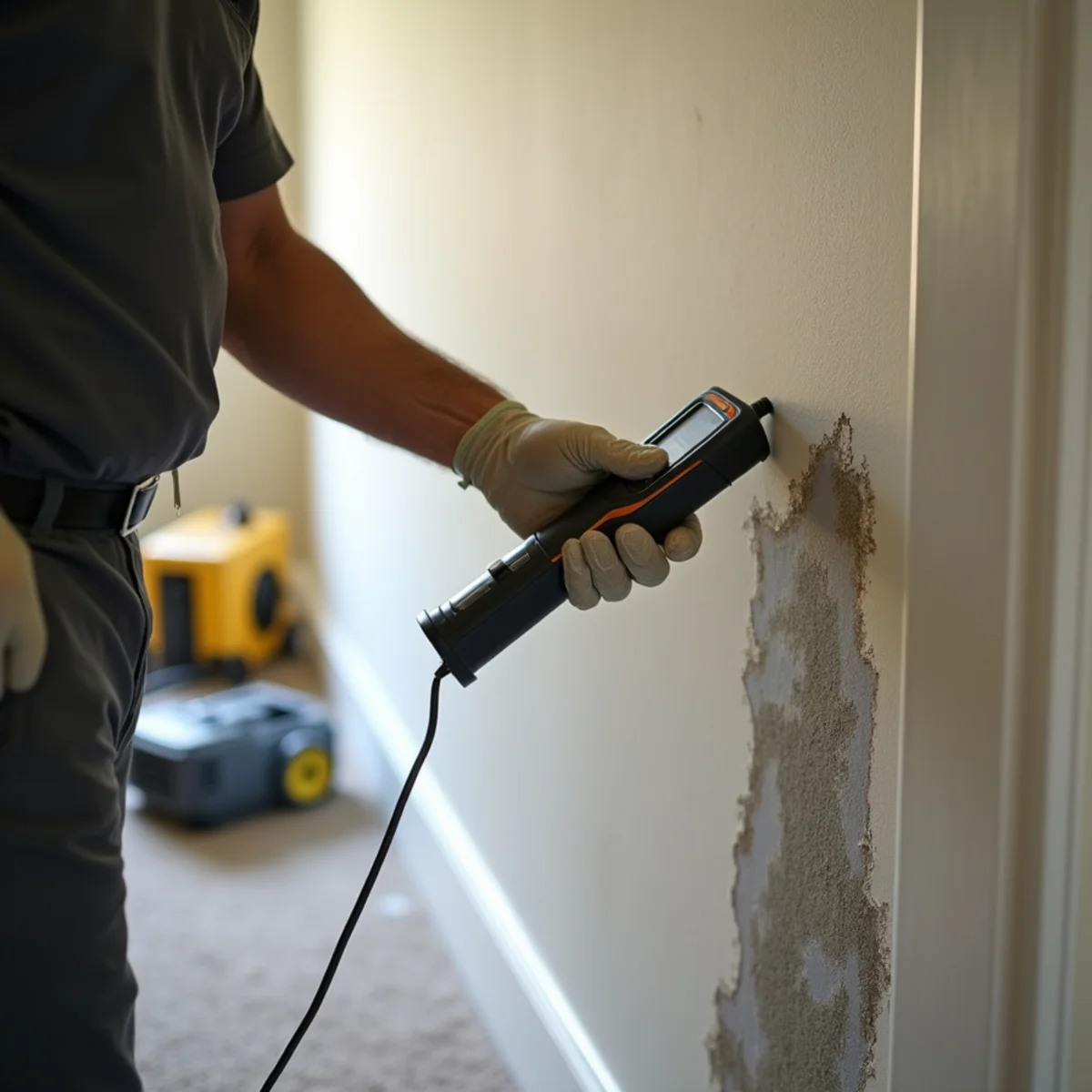
Pin meters push two probes into wood or drywall and read moisture content directly. Pinless meters scan under flooring and behind paint without holes. Thermal cameras show temperature differences, not water: evaporation cools wet drywall, but an air leak looks cool too, so every suspicious spot is confirmed with a meter.
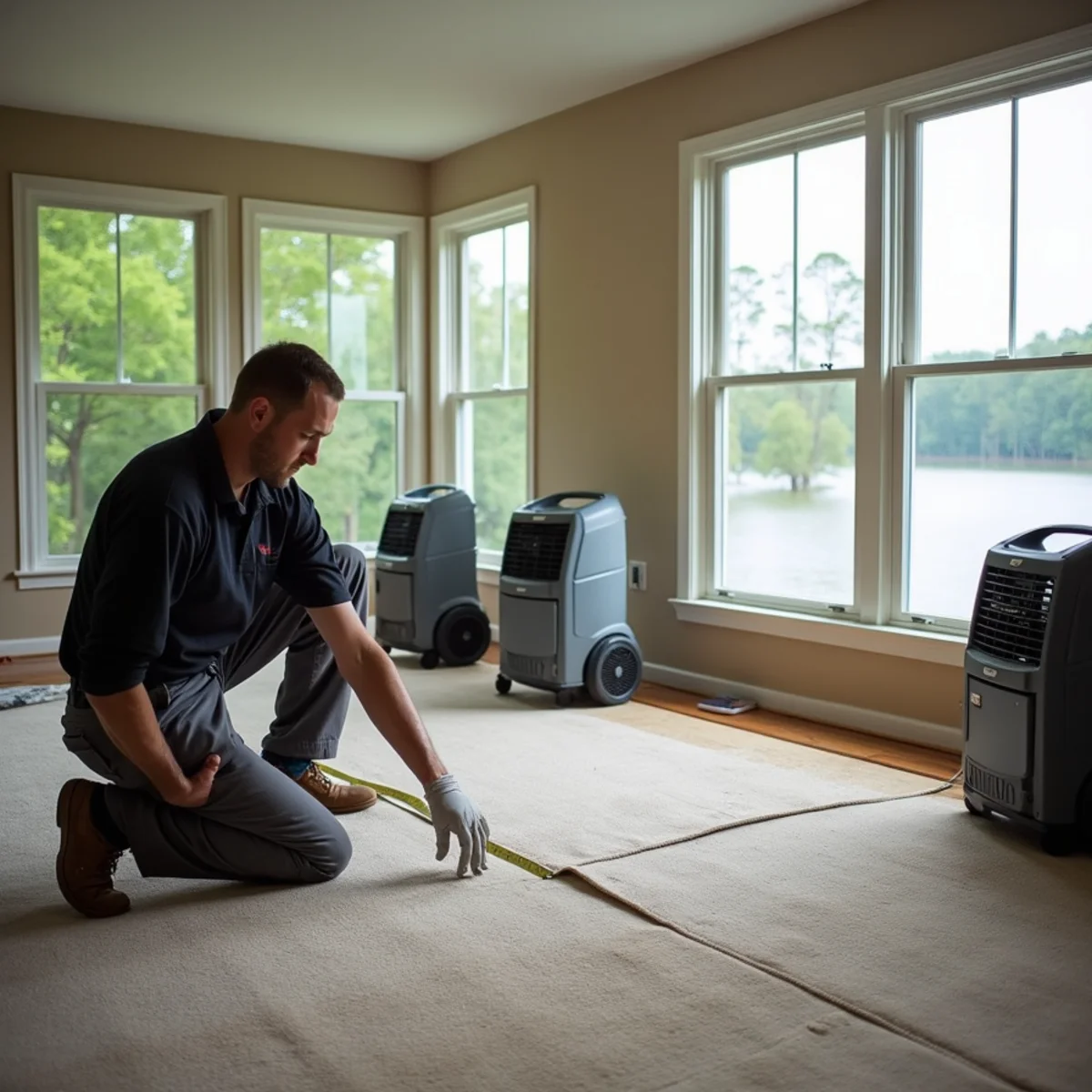
Readings go on a sketch of the house with marked spots. A reading from the same material in a room that never got wet becomes the dry standard. Drying is done when wet material reads at or near that number, not when it feels dry.
Finding the edge of the water
The technician keeps reading outward, into the next room, the closet behind the wet wall and the space below, until the numbers match the dry standard. That boundary, often running behind cabinet toe kicks and under tile, is the drying scope.
Water extraction from carpet, pad, hardwood and subfloor
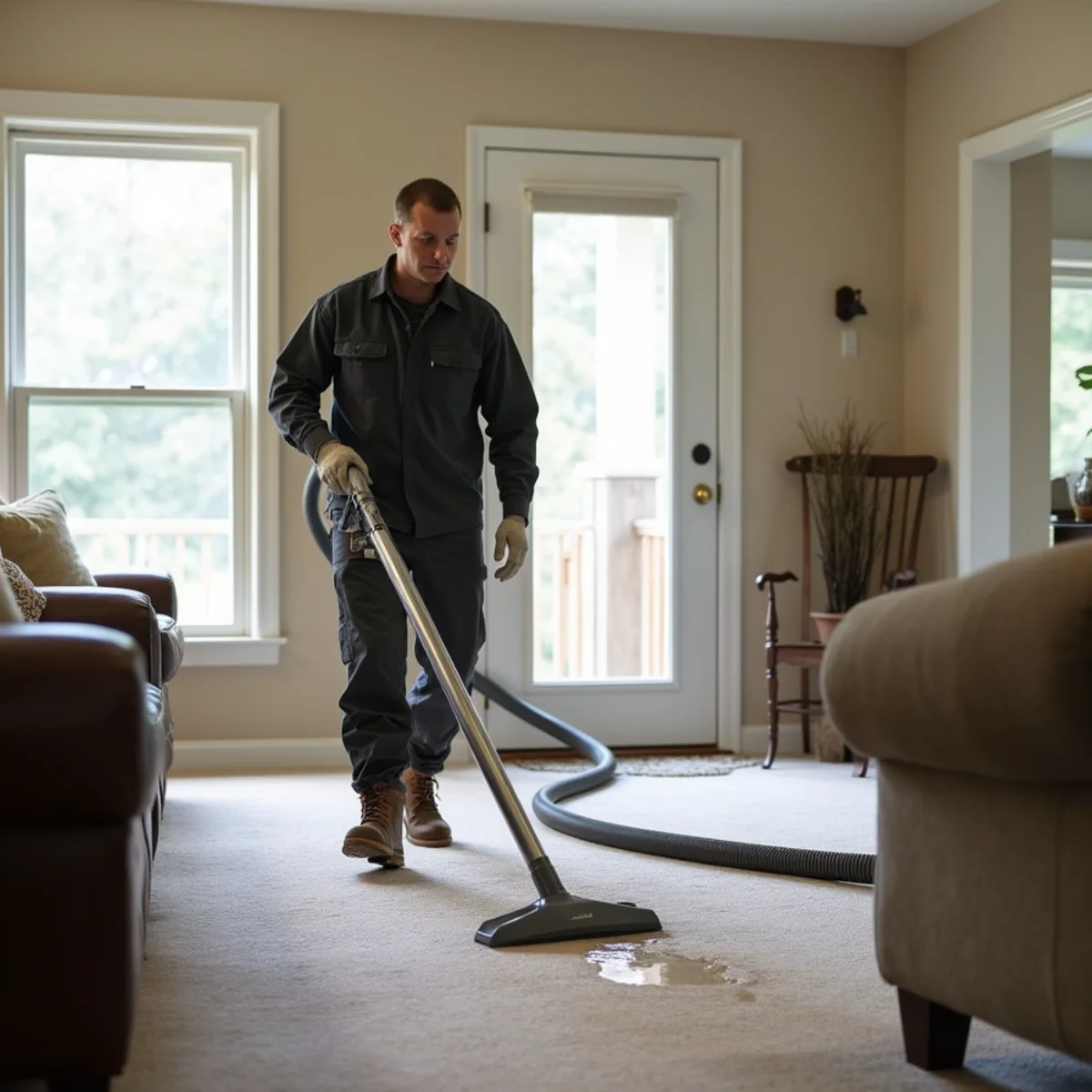
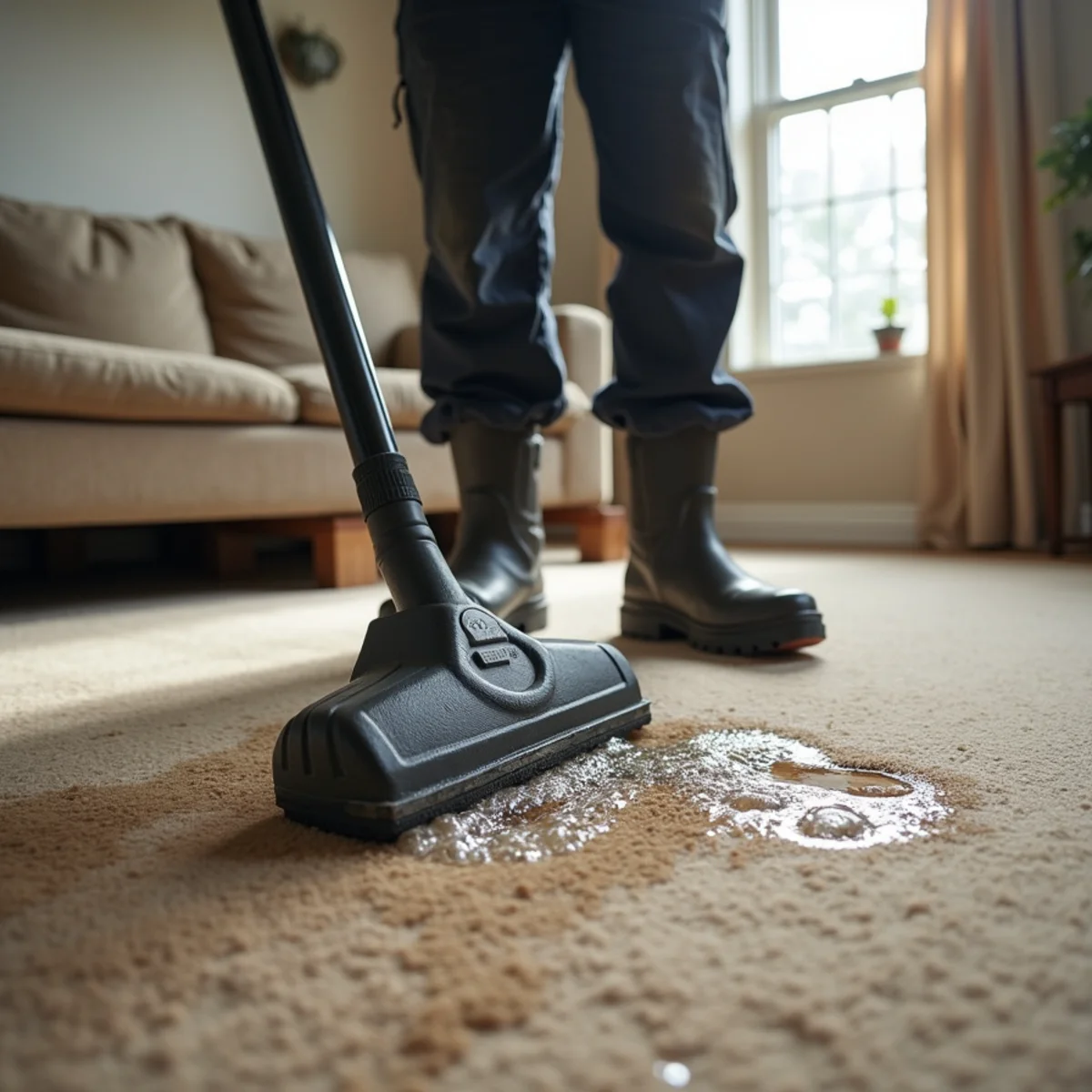
Pulling water out as liquid is far faster than evaporating it later. Every gallon out through a hose is a gallon the dehumidifiers never handle.
- Standing water: submersible pumps, then truck-mounted or portable extractors.
- Carpet and pad: a weighted tool the technician stands on squeezes both at once. Carpet often stays in a clean-water loss; pad is cheap and often replaced.
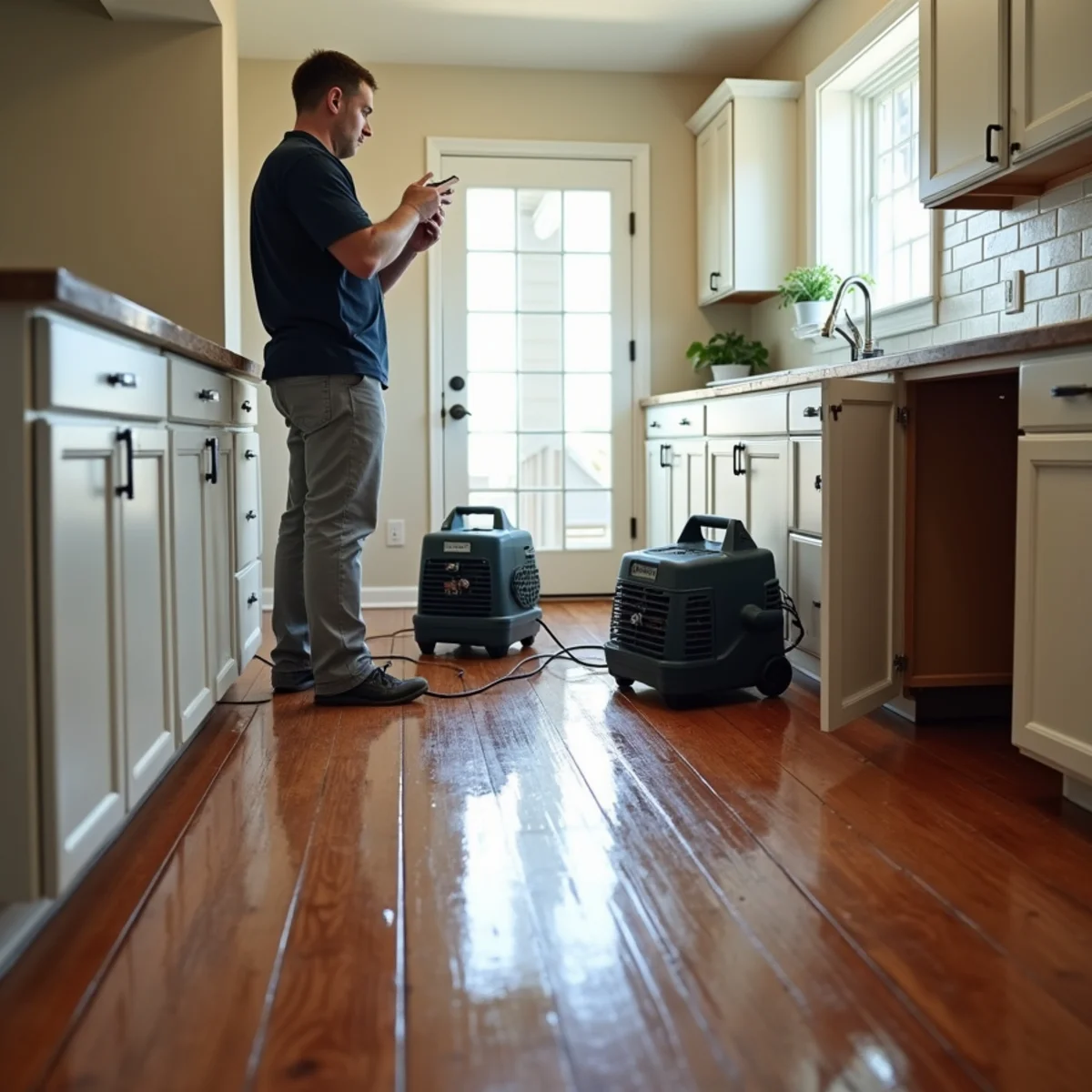
- Hardwood: squeegee wands pull water from between boards before drying mats go down.
- Laminate and vinyl plank: laminate swells and usually comes out; click vinyl plank can sometimes be lifted, dried under and relaid.
- Subfloor: wet plywood or OSB over a crawl space is dried from above and below.
Hardwood floors: cupping and panel drying mats
Wet hardwood swells more on the bottom than the top, so board edges rise and the floor cups. That is a moisture problem, not yet a ruined floor. Panel drying mats sealed to the boards and hooked to a vacuum pull moisture up through the wood.
Do not sand a cupped floor early. Boards sanded flat while wet crown as they finish drying. Refinishing waits until readings reach the dry standard, sometimes weeks after the equipment leaves.
Furniture and belongings while the floor is worked
Contents move before extraction and stay off the floor during drying:
- Heavy furniture goes up on foam blocks so wood legs do not stain the carpet.
- Rugs, electronics, papers and photos go to a dry room first.
- On larger losses, contents can be packed out for cleaning and storage while the rooms dry.
- Anything discarded is photographed and listed before it leaves.
Structural drying: air movers, dehumidifiers and daily moisture readings
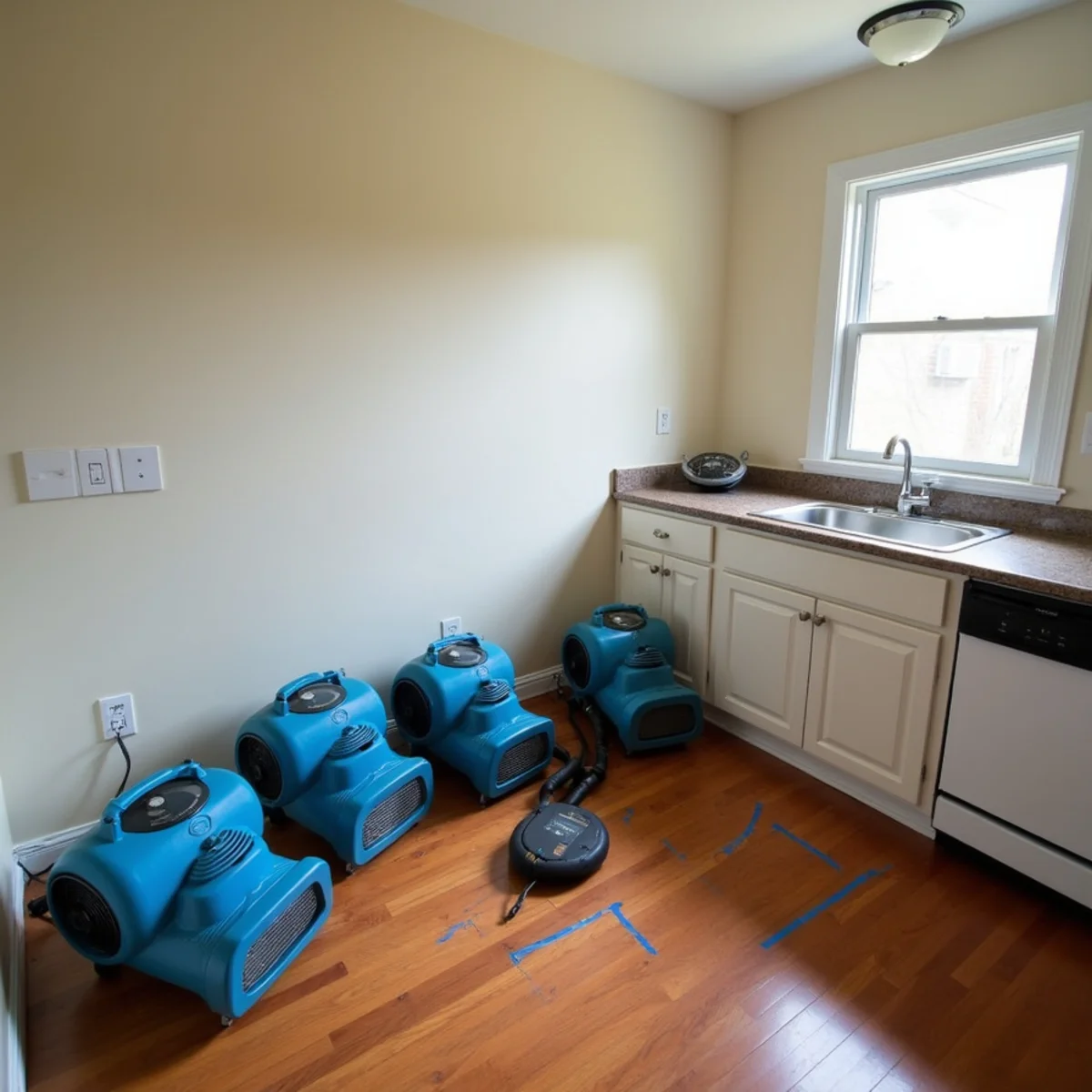
Air movers push air across wet surfaces so water leaves the material; dehumidifiers pull it back out of the air before it settles elsewhere. Too many air movers and too little dehumidification only makes a humid room.
- Air movers angled along wet walls and across floors.
- LGR (low grain refrigerant) dehumidifiers, which keep pulling water after the air is already fairly dry.
- Desiccant units for cold spaces or very dense materials.
- Wall cavity and floor systems that push air where air movers cannot reach.
- Plastic containment so the equipment dries the wet rooms, not the whole house.
Drying classes
Class 1 is a small wet area of low-absorbing material. Class 2 is a full room of carpet with water wicked a short way up the walls. Class 3 means water came from above and soaked ceilings, walls, insulation and floors. Class 4 covers dense materials like hardwood, plaster and concrete, which need drier air and more time.
Daily readings and adjustments
A technician returns daily to read the marked spots, check humidity inside and outside containment, and move or pull equipment. Readings that stall point to a wet cavity, an overmatched dehumidifier or a second leak. Ask whether the plan follows ANSI/IICRC S500, the industry water damage standard, and ask to see the log.
From May to October, Lake Norman air is warm and wet, so windows stay shut and dehumidifiers carry the load. In winter, rooms are kept warm because cold slows evaporation.
This daily math is psychrometry: the air temperature, how much water that air holds, and the moisture left in wood, drywall or flooring. If the air keeps drying but a wall reading has not moved, the equipment is misplaced or something still feeds that wall.
Before the equipment leaves
- Every marked spot, including edge rooms and the crawl space, reads at or near the dry standard.
- Final readings are written into the drying log, and you get a copy.
- Anything still drying, such as a cupped floor, has a recheck date.
When the water runs down into the crawl space
Water through a Davidson floor usually keeps going: between the joists, into the fiberglass batts, onto the vapor barrier or red clay. A kitchen that looks dry can sit over a soaked crawl space.
- Wet batts come down, since fiberglass holds water against the subfloor.
- Standing water is pumped off, and torn or soiled vapor barrier is replaced.
- Joists are read with pin meters; wood above roughly 19 to 20% moisture content supports mold and decay.
- Vents are closed during drying and a dehumidifier runs below, because summer air through open vents adds moisture.
Vented crawl spaces near the lake sit above 80% relative humidity from May through October, so a summer leak can grow mold under the floor quickly. For a crawl space that was damp before the leak, see crawl space mold removal and water cleanup.
What dries in place and what has to come out (drywall, insulation, flooring)
The aim is to save what can reach the dry standard in reasonable time and remove what cannot, based on material, category and how long it has been wet.
| Material | Usually dries in place | Usually comes out |
|---|---|---|
| Drywall | Firm, wet at the bottom, empty cavity | Swollen, sagging or stained; wet batts behind it; Category 3 contact |
| Insulation | Rarely | Wet fiberglass batts |
| Carpet | Extracted quickly, backing bonded | Backing separated, Category 3, or wet for days |
| Carpet pad | Sometimes, in quick clean-water losses | Most Category 2, all Category 3 |
| Solid hardwood | Cupped boards, with mats and time | Split, buckled or still wet boards |
| Laminate | Seldom | Swollen edges |
| Cabinets | Solid wood, toe kicks removed | Swollen particleboard bases |
| Plaster | Often, slowly | Plaster loose from its lath |
Flood cuts, weep holes and baseboards
When drywall has to go, the crew makes a flood cut, a straight line often around 2 feet up, so the wall patches cleanly. Where drywall is sound and the cavity empty, they pull the baseboard and drill small weep holes behind it to push air inside; the trim covers them afterward.
Built-ins, tile and finished lower levels
Built-in cabinets can often stay if the toe kick comes off and air is forced underneath. Tile over a wood subfloor is read through the grout and from the crawl space. A walk-out lower level on a lake lot often has carpet over a slab, which dries slowly.
Before a costly finish is torn out or left, get the reasoning: what the crew expects to save, the readings behind it, the risk if a wet piece stays, and what replacement involves.
Photos, moisture logs and your insurance claim
- Dated photos of the source, the wet areas and every material before removal.
- The moisture map, the dry standard and daily readings.
- Equipment counts and run days.
- An itemized scope separating mitigation from repairs, plus a contents list.
Add the time you discovered the leak and how it was stopped, plus receipts for emergency purchases, the plumber and any hotel stay, and keep copies.
Crews can meet your adjuster on site. Keep the failed part, such as a split supply line; adjusters often ask for it. Many North Carolina policies cover sudden discharge but not long-term leaks or outside floodwater, which needs a separate policy, such as one through the National Flood Insurance Program. Read your policy and ask your agent; the NC Department of Insurance also explains homeowners coverage. Our guide to homeowners insurance and water damage in North Carolina explains the usual lines.
What affects cost and drying time
Jobs are priced after the readings, with the scope and price in writing before work starts. What moves the price and the days:
- Wet square footage, rooms and floors.
- Water category and the removal it forces.
- Materials: hardwood, plaster and crawl spaces need more equipment and time.
- Hours before work started.
- Season: summer humidity and cold winter rooms both slow drying.
- Access and contents to move.
- Rebuild, quoted separately.
Reading a drying estimate
Drying is priced in line items, often in Xactimate estimating software, or as time and materials. Look for extraction by area, each material removed and equipment per day. The day count is a forecast; ask how added days are approved.
Many Category 1 losses in drywall and carpet dry in three to five days; hardwood often takes a week or more. See what drives water damage restoration cost around Lake Norman. Crews also handle water extraction in Cornelius and every town on our service areas around Lake Norman page. Call (831) 303-1192 to describe what is wet.
Why Davidson calls Ultra Mold & Water for water extraction & drying
A live answer, day or night
A person picks up (831) 303-1192 24/7 and sends the nearest available crew to your Davidson address.
Dried to a number, not a feeling
Daily moisture readings on marked spots, compared with a dry standard taken from unaffected material in your own house.
Scope and price before work
You get the scope and price in writing before extraction starts, with drying and rebuild listed separately.
Records your adjuster can use
Photos, moisture maps and daily drying logs, plus a crew that can meet the adjuster on site.
Every restoration technician we send is licensed where North Carolina requires it, and insured.
Water Extraction & Drying: common questions from Davidson homeowners
How fast can a crew reach my home in Davidson?
A person answers (831) 303-1192 24/7 and sends the nearest available crew. Arrival depends on where that crew is and on traffic along I-77 and NC-115, so the dispatcher gives you an estimate on the call rather than a fixed promise. Meanwhile, stop the water if you safely can and take photos.
How long does it take to dry a house after a leak?
Many clean-water leaks in drywall and carpet dry in three to five days. Hardwood, plaster, crawl spaces and Class 3 or 4 losses take longer, sometimes two weeks. The job ends when readings reach the dry standard, not on a set date.
Can wet hardwood floors be saved?
Often, if drying starts early. Cupped solid hardwood usually flattens as drying mats and dehumidifiers bring its moisture down. Boards that buckle, split or stay wet are replaced. Do not sand or refinish until readings match a dry area of the same floor.
Are the technicians insured, and does North Carolina license this work?
Every restoration technician we send is licensed where North Carolina requires it, and insured. North Carolina has no state license for water damage restoration itself. Plumbing and electrical repairs need NC-licensed plumbers and electricians, and larger rebuilds fall under the state's general contractor licensing law.
Who decides when the drying equipment can come out?
The readings, not the calendar. Every marked spot, including the edge rooms and the crawl space under the wet floor, should read at or near the dry standard from unaffected material in your house. Final numbers go into the drying log you receive. If one area lags, such as hardwood, the equipment there stays.
Can kitchen cabinets and tile floors be dried without tearing them out?
Often, in a clean-water loss caught early. Solid wood cabinets usually stay once the toe kicks come off and air reaches the base; swollen particleboard rarely recovers. Tile over a wood subfloor can stay if the subfloor dries and the tile is still bonded. Ask which readings back each decision.
Water Extraction & Drying beyond Davidson
The same crews cover the Lake Norman towns around Davidson, 5 to 35 minutes out by I-77, NC-115 and NC-73. See how water extraction & drying plays out in the housing stock of each town, or view all water damage service areas.
- Water Extraction & Drying in Cornelius
- Water Extraction & Drying in Mooresville
- Water Extraction & Drying in Huntersville
Also serving Kannapolis and Concord.